The Executive Protocol Vault
The complete library of 24 practical parenting tools and protocols (including the 7am Meltdown Protocol, Family Portrait Negotiation, and Routine Engineering). Delivered digitally.
Your child isn't broken. The modern world is just incredibly hard to parent in. We built a smart, interactive quiz to help you understand exactly why your family feels chaotic—and give you the simple steps to calm it down.
Why modern parenting feels so exhausting, and why the strategies you use at work are failing at home.
The Problem: When you’re highly capable at work, you naturally try to manage your household the exact same way—using strict schedules, logic, and efficiency. But children aren't employees. Treating your home like a corporation drains all of your energy, leaving you too exhausted to actually connect with your kids.
The Problem: Kids need a calm, predictable environment to feel safe. Sadly, the modern morning routine forces tired children to rush out the door, often made worse by watching screens before school. If you rely purely on yelling and willpower to get everyone ready, you're guaranteeing a stressful meltdown. You need simple routines, not more rushing.
The Problem: When we worry about too much screen time, our first instinct is to become a strict warden—taking iPads away and setting harsh timers. This almost always makes kids rebel and fight back. Constant restriction doesn't work. The real solution is learning how to guide them and build healthy digital habits together.
You run your home like a flawless startup… but it's quietly causing stress.
We analyzed 6 distinct evolutionary behavioral patterns. Here is absolutely transparent data showing exactly how your nervous system responded across all spectrums.
Stop relying on willpower alone. You cannot fight an evolutionary mismatch with sheer effort. You need to read the manual, and install the system. Choose your implementation path below:
The complete library of 24 practical parenting tools and protocols (including the 7am Meltdown Protocol, Family Portrait Negotiation, and Routine Engineering). Delivered digitally.
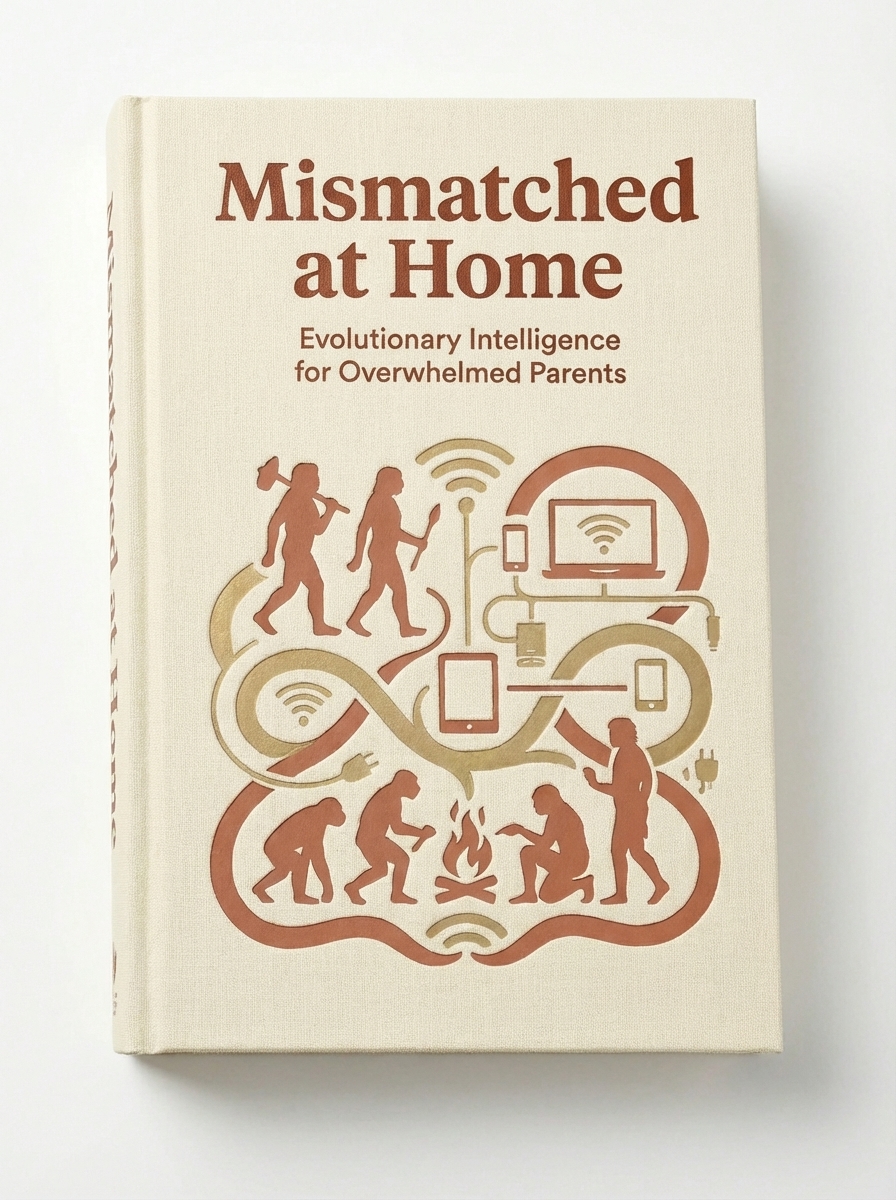
The eye-opening anthropological guide exposing why the modern home environment clashes with our evolutionary biology, and how to fix the friction. Ebook & Audio formats.
Get the ultimate combination. Understand the "why" with the anthropological insights of Mismatched at Home, and implement the "how" with all 24 practical tools in The Executive Protocol Vault.
Preview the foundational anthropological insight from Mismatched at Home.
When we look back at the history of our species, Homo sapiens, we often mistake our raw intelligence as the sole reason we conquered the planet. We point to the discovery of fire, the invention of the wheel, or the building of the pyramids as evidence of our individual genius. But a single human being, left entirely alone, is a remarkably weak and fragile creature. If you were to drop a solitary genius onto the African savannah seventy thousand years ago, they would likely perish within a week—a victim of exposure, starvation, or a passing predator. What truly separated us from the Neanderthals, and eventually from all other animals, was our unparalleled ability to cooperate dynamically in large numbers.
Nowhere is this evolutionary superpower more obvious—and more necessary—than in the raising of a human child.
Human babies are born astonishingly useless. Unlike a foal that can run hours after birth, or a kitten that can hunt within a few weeks, a human infant remains utterly helpless for years. Its brain is massive yet severely underdeveloped, requiring a staggering amount of calories, constant physical protection, and an uninterrupted stream of social and emotional data to finish forming. From an evolutionary perspective, the burden of raising even a single human offspring is so overwhelming that no solitary creature could ever manage it successfully.
For the vast majority of human history, child-rearing was never designed to be the responsibility of just one or two individuals. For tens of thousands of years, Homo sapiens lived in close-knit, interdependent bands of fifty to one hundred and fifty people. Let us imagine a typical forager band fifty thousand years ago. When a baby was born, it did not belong to a private, isolated household. The survival of that child belonged to the tribe. The cognitive and physical heavy lifting of parenting was distributed across a vast network of functioning adult brains.
This system is known to evolutionary biologists as "alloparenting"—parenting by others. An infant was carried by an aunt, fed by a grandmother, played with by older children, and taught to forage by uncles and neighbors. The biological parents were certainly important, but they were never alone. If a mother was exhausted, a sister took the baby. If a father was injured, the tribe ensured the child was fed and protected. The tribe acted as an immense, resilient buffer against the extreme volatility of raising human offspring. The parents did not need to negotiate every minute of "who does what," because the physical presence of the social structure provided a constant, unspoken safety net.
Then came the first great fracture: the Agricultural Revolution.
About twelve thousand years ago, Homo sapiens stopped following the herds and began to settle down. We planted wheat, domesticated animals, and built permanent dwellings. With the advent of agriculture came a radical new consequence: private property. As people began to own land and accumulate surplus wealth, the focus shifted from the survival of the band to the prosperity of the bloodline. Slowly, the borders of the tribe began to shrink. The concept of "my child" and "my inheritance" began to supersede the ancient concept of "our child." The safety net tightened around the extended family rather than the entire village. However, even throughout the Agricultural era, the extended family remained largely intact. Grandparents, cousins, and adult siblings generally lived on the same plot of land or in the same farming village. Multiple generations still worked together and shared the immense daily burden of child-rearing. The village had transformed, but it had not yet died.
It was the Industrial Revolution that delivered the fatal blow to the village.
In the span of just a few centuries, the factory system radically altered the physical and social geography of humanity. The new capitalist economy did not need extended families anchored to a piece of ancestral land. It required mobile, interchangeable units of labor that could move to whichever city a factory or a corporate office was being built in. The extended family was shattered. Young couples moved from agricultural villages into crowded, anonymous urban centers in search of wage labor. For the first time in the history of our species, the "nuclear family"—comprising only two parents and their immediate offspring—became the standard unit of human society.
Today, we take the nuclear family for granted. We assume it is the natural, default setting of human existence. In reality, it is a sudden, unnatural, and historically bizarre arrangement.